Catalogue record
3rd World Farmer
3rd World Farmer Team
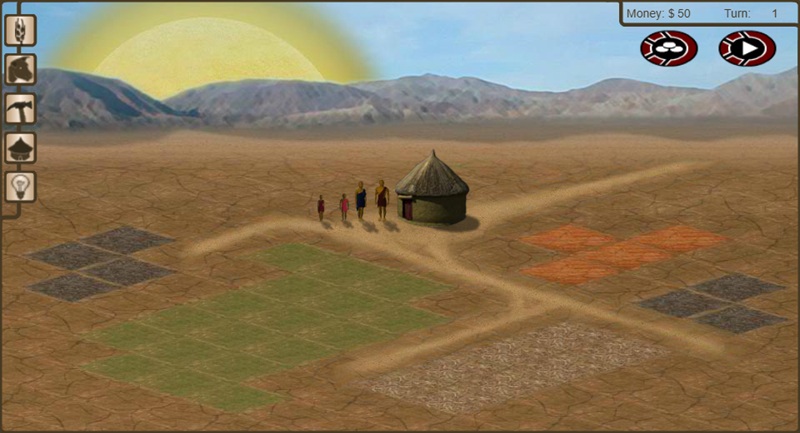
You look after one farming family in Africa. Each turn is one year. You have very little money and you must decide how to use it. Buy seeds and plant crops. Buy an animal, a tool or a shed. Send a child to school, or buy medicine when someone is ill. You can also put money into projects for the whole village. Then you harvest, and you read a short report on the year. After that, something happens that you did not choose. A good harvest. A drought. Illness. Armed men who take your animals. Officials who take your savings. Sometimes a family member dies. You begin the next year with whatever is left, and you decide again. The game ends when the family dies out, or when you decide to stop.
Our review
A hard lesson about thin margins
A dated but still useful simulation of rural poverty and risk, best used to prompt discussion rather than as a realistic picture of contemporary African farming.
- Learning value3/5
- Engagement3/5
- Sector realism2/5
- Accessibility4/5
3rd World Farmer is a browser game about rural poverty. It started as a student project at the IT University of Copenhagen in spring 2005 and has been kept going since by the same small Danish team. The game was most likely launched in 2006.
The browser version is free and needs no installation. It runs on desktop, tablet and phone. It was rebuilt in HTML5 after Adobe Flash closed down in January 2021, so it still works in modern browsers. There are eleven languages, all made by volunteers: English, Spanish, Danish, Czech, French, Italian, German, Hungarian, Brazilian Portuguese, Chinese and Turkish. There is also an Android app, released in January 2020, but that one costs money.
The developers do not say how long a game takes. A run ends when the family dies out or when you stop, so sessions are short and you can play again quickly.
What is it for?
The developers call it an experiment. They say it shows some of the things that cause and keep people poor, and that the aim is to make people think, not to teach a course. Their about page says openly that the game is not accurate in every detail. There are no published learning outcomes. Their manual site collects lesson plans written by teachers, and lists use in geography, economics, social science and language classes, and by relief agencies. The game does not show aid organisations, their decisions, or how they work together. It shows a household.
There is some evidence that this works as a classroom discussion and learning activity, although it is limited. A 2011/2012 classroom study used the game with 25 ninth-grade students in geography. The study found that the game motivated students and supported the development of different geography skills. It was a descriptive classroom study, however, not a controlled test of what students retained or whether playing the game caused the learning.
How do you play it?
Each turn is one year. You split a very small budget between crops, animals, tools and farm buildings, and you can also pay for village projects. You click on family members to send a child to school, buy medicine, have a child, or send someone to the city to earn money. Then you harvest and read the yearly report. Then the event of the year arrives, and you cannot control it.
Losing is normal, and it is meant to be. People die. Animals and tools are stolen. The only feedback is the report and the money you have left. The game never explains why your plan failed, which is why a discussion afterwards matters so much.
Is it any good?
It teaches one thing very well: a poor household can make sensible choices and still lose everything, because bad years arrive faster than savings grow. Growing different crops, buying storage and sending children to school are all good decisions, and the game shows how little room there is to make them. That is close to what our sector means by reducing risk and protecting livelihoods.
It rewards playing more than once. A political science teacher who used it in class put it well: the learning is in the losing. First you lose badly, then you understand why, then you build a farm that survives — and only then do you see how much difference the village projects make. One play is not enough. They also suggest playing it as a group, with everyone deciding together, which works better than twenty people playing alone in silence.
The academic literature broadly supports using the game as a discussion and simulation tool. A 2015 review of 49 sustainable-development games classified 3rd World Farmer as an online sandbox game about sustainable agricultural land use, while a 2014 review of serious games described it as a simulation intended to sensitise players to the hardships of farming in developing countries. Neither study is an evaluation of learning from this game itself, but both place it firmly in the educational serious-games literature.
The limits are real. The setting is a general Africa with no country, no market prices you can study and no named institutions, so you cannot use it to teach any real place. It is nearly twenty years old and has not kept up with current thinking on cash transfers, insurance or climate adaptation; the weather is simply a random event. Corruption and outside investors are in the game, but only lightly — you can pay a bribe or take company money, and the game notes the cash without showing what it costs you later.
There is also a representational problem. An academic critique of serious games specifically identifies the game's “Third World” terminology as outdated and colonial. The problem is broader than the title: the setting is an unnamed African country and the game concentrates heavily on poverty, drought, disease, conflict, corruption and deprivation. That does not make the simulation unusable, but it means it is better treated as a deliberately simplified model of poverty and risk than as a picture of African farming.
We found classroom research showing that the game can motivate students and support skills development, but no strong study showing what players retain over time or whether playing it changes their understanding or behaviour beyond the classroom. So the evidence is better than “never evaluated”, but still fairly thin.
Two practical warnings. Family members die often, and some groups will find that upsetting; say so before you start. And for a game set in Africa, translated by volunteers into eleven languages, there is no African language and no Arabic version.
Who is it for?
Use it as a short opening activity with students, volunteers or new staff, followed by a proper discussion. Tell players that the family members can be clicked, and that each one can do something — go to school, take medicine, look for work in the city. It is easy to miss. Let them play twice. Do not use it as evidence about any real country, and do not use it with experienced field staff who expect to see their own work.
Game details
Core Humanitarian Standard alignment
No Core Humanitarian Standard requirements are mapped for this record. No organisational practice is depicted, so any mapping would be inference by analogy rather than evidence.
Ready to use
Learning and teaching materials
- 3rd World Farmer Manual
The developer's manual and teaching resource site, with hints, instructions, an educators subpage collecting lesson plans shared by teachers, and a page listing academic writing that mentions the game.
Sources
- 3rd World Farmer — Other
Wikipedia page of the game
- An Overview of Serious Games — Academic publicationFedwa Laamarti, Mohamad Eid, Abdulmotaleb El Saddik · 2014 · International Journal of Computer Games Technology
This paper reviews digital serious games across a wide range of application areas, including education, health, well-being, cultural heritage and communication, and proposes a taxonomy for classifying them. It also draws on the literature to identify design and development guidelines and future research directions for successful serious games.
- Edutainment for Sustainable Development: A Survey of Games in the Field — OtherKorina Katsaliaki, Navonil Mustafee · 2015 · Simulation & Gaming 46(6)
A methodological review of 49 sustainable-development games that includes 3rd World Farmer as an online sandbox game dealing with sustainability of agricultural land use.
- O 3RD World Farmer como ferramenta promotora de competências geográficas no 9º ano — OtherPaula Simões · 2012 · Universidade Aberta
Master's dissertation
- Serious games: video games for good? — Academic publicationKathy Sanford, Lisa J Starr, Liz Merkel, Sarah Bonsor Kurki · 2014 · E-Learning and Digital Media 12(1)
This paper explores how young people perceive and analyse serious games, particularly how they compare with mainstream entertainment games and how global issues are represented. It argues that designers need to take players’ experiences and perceptions seriously when developing games as educational tools for children and young people.
- The Children’s rights education via game-based activities: An intervention in kindergarten — Academic publicationTheonia Sakka, Dimitris Gouscos 10(1) · 2023 · International Journal of Serious Games
This paper examines how digital games can be used to introduce preschool children to children's rights, finding that they supported creative thinking, dialogue, ethical reasoning and social reflection. It highlights the potential of games for rights-based education while noting the need for further research involving both children and parents.