Catalogue record
Bury Me, My Love
The Pixel Hunt, Figs and ARTE France
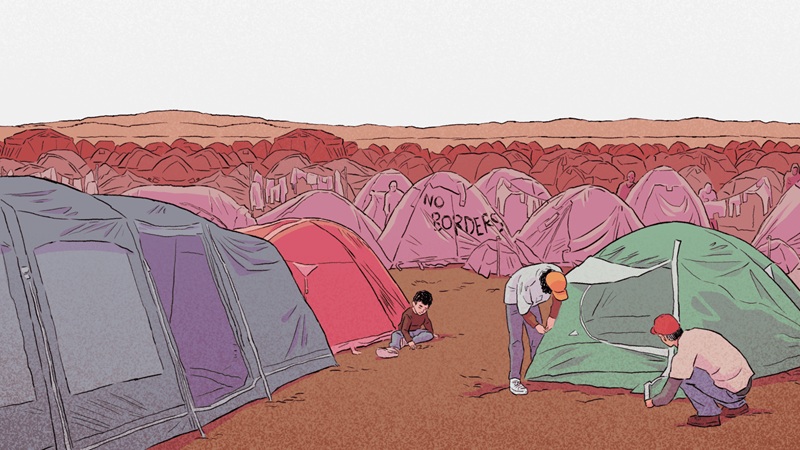
You are Majd. Your wife Nour has left Syria to try to reach Europe, and you have stayed behind. Everything happens inside a messaging app: she writes to you from the road, sends photos and voice notes, and you reply by picking from a short list of prepared answers. You cannot take a reply back. She asks for directions, for an opinion about a smuggler, for a decision about a border crossing — then she decides for herself what to do with what you told her, and sometimes she ignores you. There is no score and no game over screen. Nour can pass through fifty places and the story can end in nineteen different ways, from arrival to detention, separation and death. The ending you reach is the only feedback you get.
Our review
Advice you cannot take back
A rare game that makes remote advice feel consequential; strong for empathy and awareness work, weaker as a picture of humanitarian practice itself.
- Learning value3/5
- Engagement4/5
- Sector realism2/5
- Accessibility5/5
Bury me, my Love is a text-messaging interactive fiction made by The Pixel Hunt with Figs and ARTE France, released on mobile in October 2017 and later ported to Windows and Nintendo Switch in January 2019. It is cheap — around five euros at full price, and the Steam listing is frequently discounted by 75 per cent or more. The store listings are live and the game still runs. The interface is available in English, French, German, Italian, Spanish and, Japanese. Strangely there is no Arabic version. A single playthrough takes upwards of two hours in fast-track mode; played in real time, where Nour's messages arrive when she sends them, one story stretches across roughly two weeks. The real-time design is one of the game's most important features.
What is it for?
Awareness for the general public, not professional training. The studio calls it a reality-inspired game. It draws on a December 2015 Le Monde piece by Lucie Soullier about Dana, a young Syrian woman who fled to Germany, and both Soullier and the woman whose journey it follows consulted on the script. The makers state no formal learning outcomes and supply no facilitator guide or debrief material. It does not set out to teach asylum law, registration procedures or how an aid organisation works. It won prizes at the International Mobile Gaming Awards, the Emotional Games Awards and Japan Prize 2018.
The academic literature supports the game's value as a representation of forced migration, rather than as a tested educational intervention. A 2022 Game Studies article argues that its real-time messaging mechanic communicates the temporal uncertainty and disruption of refugee experience. A 2024 article in the Journal of Ethnic and Migration Studies places it among a small group of games that use interactive narrative to put players into moral dilemmas around migration, while also warning that such games can struggle to connect an individual migrant's experience with the larger political and structural conditions shaping migration. A 2023 scoping review similarly identifies Bury Me, My Love as a game that can introduce players to sudden migration, ethical dilemmas and the political conditions surrounding refugees.
How do you play it?
You chat with your wife on your phone. You read what Nour sends, you pick one of a few replies, and it is gone — no undo, no score, no map, just a phone and whatever you happen to know.
Then you wait. The condensed version becomes tiring, so play it in real time if you can, which in practice means on a phone. It works surprisingly well: a message arrives while you are on the bus home, and learning about Nour's fate does seem real. Academic analysis of the game makes the same design point from a different angle: the waiting is not just part of the story, it is part of what the game is trying to communicate about forced migration. Save the fast-track mode for a session that has to fit inside a room and a timeslot.
The nineteen endings only open up on replay, choosing differently each time. Keeping track is hard, and doing it repeatedly is both time consuming and emotionally heavy.
Is it any good?
Yes, within its aim, and two things in it work unusually well for a humanitarian reader.
The first is that information has a shelf life. Advice that arrives late or vague changes where Nour goes. In real time this is visceral: you type something, she does not reply for hours, and you sit with it. A peer-reviewed analysis in Game Studies by Elizabeth Nijdam examines this use of elapsed time as the game's central device, arguing it puts the player inside the waiting rather than describing it to them.
The second is that you never control her. You practise supporting someone else's decision about her own life instead of making it for her — a discipline the sector talks about constantly and almost never gets to rehearse. Most games about crises hand the player a lever. This one hands them an opinion. A 2026 peer-reviewed study makes a related point from the perspective of transnational care: the messaging interface makes visible emotional labour, temporal uncertainty and the limited agency of people trying to support someone at a distance.
The limits are real. We could not find a study measuring whether players actually learned or retained specific knowledge from the game, so its educational impact remains unproven. The academic literature is much stronger on representation, temporality, ethics and the emotional experience of migration than on learning outcomes. Humanitarian actors barely appear: this is the experience of displacement, not the work of responding to it, and a reader looking for how a response functions will not find it here.
The absence of Arabic is worth naming plainly — a game about a Syrian woman, built with input from the woman whose journey inspired it, that is still not available in Arabic on the current major store listings. At the same time, that should not obscure what the research says about the game's representational care: the woman whose journey inspired it was involved in the writing and checked the game's details, which is an unusually direct form of consultation for a game of this kind.
Who is it for?
Use it for awareness sessions, induction, and protection or migration teams, with your own debrief and with several players comparing different endings.
What it offers is not the refugee's experience — you stay safe the whole time — but something practitioners rarely get: caring about one specific person in danger and being unable to reach her. Most of us meet displacement as caseloads and figures. Few have sat with a phone waiting to hear whether someone we love is alive, though colleagues from affected communities often have. That closeness is what makes the moments land where no organisation was anywhere near her.
Game details
Core Humanitarian Standard alignment
No Core Humanitarian Standard requirements are mapped for this record. No organisational practice is depicted, so any mapping would be inference by analogy rather than evidence.
Ready to use
Learning and teaching materials
- Bury Me, My Love: Identity in CrisisUNESCO MGIEP
This is a game-based course explicitly built around Bury Me, My Love. UNESCO describes it as a course following Nour's journey and exploring migration, home, belonging and identity.
- Games im Unterricht — teaching unitGames im Unterricht · 2020
This is a 3-lesson teaching unit specifically for Bury Me, My Love. It has learning activities based on the game, including comparing players' different routes and discussing flight and migration.
- Südwind — Bury Me My Love pedagogical sequenceSüdwind · 2025
A 22-page teaching sequence specifically for the game, published in 2025.
Sources
- ARTE France — Official website
Official website of the developer
- Migration and interactive narrative in video games: scale, ethics, and experience — Academic publicationMarco Caracciolo · 2024 · Journal of Ethnic and Migration Studies 50(20)
This study examines how contemporary indie video games represent migration and encourage players to engage with its complexity through moral dilemmas. Focusing on Papers, Please, Bury Me, My Love, Frostpunk, and Where the Water Tastes Like Wine, it explores the balance between empathy for individual migrants and understanding the broader forces shaping migration. The study argues that games can reflect the complexity of migration while encouraging more critical and reflective perspectives than traditional media.
- Playing Against Real Time: Queer(ing) Temporalities in Bury me, my Love — Academic publicationElizabeth 'Biz' Nijdam · 2022 · Game Studies 22(1)
This article examines the 2017 interactive fiction Bury me, my Love (BMML) as a case study to determine the extent to which games about forced migration can engage with broader debates on forced migration. In particular, the article explores how BMML offers a unique perspective on refugee temporalities by challenging conventions of game time and reshaping player expectations.
- Steam — Developer page
Official Steam Store page
- The Pixel Hunt — Developer page
Official website of the developer
- The potential of games for vulnerable groups like refugees: a scoping review — Academic publicationCarla Sílvia Fernandes, Maria Joana Campos, Andreia Novo Lima, Suellen Cristina da Silva Chaves, Eliana Cristina dos Santos, Dárcio Tadeu Mendes, Maria do Perpétuo Socorro Sousa Nóbrega · 2023 · Rev Esc Enferm USP 57
This study is a scoping review of games designed for refugees, examining how they can support empathy, awareness, human rights education, and integration. The researchers identified eight games published between 2016 and 2022, with most designed to increase empathy by allowing players to experience or understand refugees’ perspectives and challenges. The study concludes that games have potential for reducing stigma, increasing empathy, and supporting the training of health professionals, although more research is needed to evaluate their effectiveness.
- Vidas (Des)conectadas: Intimidade Mediatizada e Vulnerabilidade Transnacional em Bury Me, My Love — Academic publicationCátia Ferreira · 2026 · Vidas Transnacionais e Contextos Culturais 26(13)
This study examines how the digital game Bury Me, My Love represents vulnerability and care during forced migration through the story of a Syrian refugee and her husband communicating remotely. It explores how delayed communication, limited choices, and unpredictable consequences represent the emotional uncertainty and restricted agency of long-distance care. The study argues that digital games can create spaces for empathy, ethical reflection, and critical engagement with the realities of displacement.