Catalogue record
Darfur is Dying
TAKE ACTION games
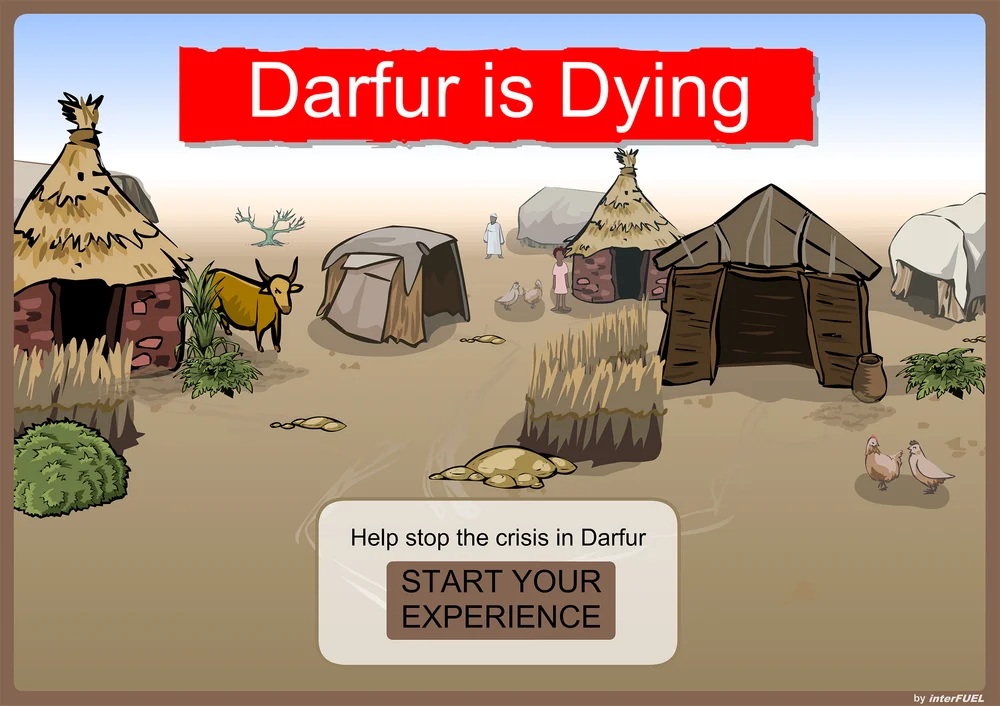
You play a member of a Darfuri family living in a camp for displaced people in Darfur, Sudan. When the camp needs water, you choose one family member to fetch it from a distant well. You steer that person across open desert and hide behind rocks and bushes when militia patrols drive past in trucks. If a patrol sees you, the character is captured and lost for good, and a text screen describes the abuse that captured people suffer. If you bring water back, the view changes to the camp. You use the water for crops and mud bricks for huts, and you watch the camp's health and threat level. The game also invites you to write to US politicians or share the game, and ties these actions to the camp's survival chances. The game ends in survival after seven days, or in failure if the camp's health runs out or no family member can fetch water.
Our review
A controversial advocacy game, not a training tool
Darfur is Dying is a widely played advocacy game, but it has limited value as humanitarian practice training and the original Flash version no longer runs natively in modern browsers
- Learning value2/5
- Engagement3/5
- Sector realism2/5
- Accessibility2/5
Darfur is Dying is a free browser game about survival in a camp for displaced people in Darfur, Sudan. Graduate students at the University of Southern California made it, led by Susana Ruiz and Ashley York under the name TAKE ACTION games. It won the mtvU Darfur Digital Activist competition among others, organised in partnership with the Reebok Human Rights Foundation and the International Crisis Group; the prize was a $50,000 grant.
The game was launched on 30 April 2006 at the “Save Darfur: Rally to Stop Genocide” in Washington, DC. Contemporary reporting described it as a narrative-based simulation intended to raise awareness, serve as a call to action and engage college students.
The game was built for Adobe Flash. Adobe ended Flash Player support on 31 December 2020 and blocked Flash content from running in Flash Player from 12 January 2021. The original game's archived website therefore no longer provides a normal modern-browser experience, although archived copies remain available and can be played through Flash emulation.
What is it for?
The makers aimed the game at university students and the wider public. The contemporary launch announcement described it as a way to spread awareness of the genocide in Darfur, serve as a call to action and empower college students to respond. This wording reflects the advocacy campaign's terminology in 2006 rather than a statement about the present-day status of the conflict.
It does not try to train humanitarian staff. The player is a displaced civilian, not an aid worker, and the game's central systems concern survival, water, food, shelter, security and camp management rather than humanitarian programme delivery.
Humanitarian aid workers with extensive on-the-ground experience in Darfur advised the students during development. The team also consulted the International Crisis Group and other activists, scholars and people with experience of the region.
The developer later acknowledged an important limitation: the team did not have the opportunity to speak with Sudanese experts who were closer to the politics and history of the region, and explicitly identified this as inconsistent with its own goal of ethical design.
How do you play it?
The game alternates between the water run and the camp view. In the first section, the player chooses a member of the displaced family and travels from the camp to a distant water source while trying to avoid militia patrols. If the character is captured, that person is lost from the playable family and the game presents text describing the consequences.
Returning with water takes the player back to the camp-management section, where water is used for crops and construction while the player monitors camp conditions and the threat posed by attacks. The game therefore combines a short stealth sequence with a resource-management loop. Ian Bogost's contemporary analysis described the water-fetching section as more effective at conveying a personal experience of genocide than the more conventional resource-management section.
The game also incorporates real-world activism into its mechanics. The developer says players could improve their chances of virtual survival by taking actions such as petitioning US representatives, writing to decision-makers, encouraging campus divestment and sharing the game with others.
The original activist links can no longer be tested reliably because the original Flash-based website is no longer operating in its original form.
Is it any good?
The strongest evidence concerns role-taking and willingness to help, rather than humanitarian knowledge or professional competence. Peng, Lee and Heeter (2010) conducted two online experiments. In the first, playing Darfur is Dying produced greater role-taking and greater willingness to help Darfurian people than reading a text conveying the same information. In the second, game playing again produced greater role-taking and willingness to help than both watching the game and reading the text.
That evidence should not be stretched further than the study allows. It measured role-taking and willingness to help; it did not establish improved humanitarian professional knowledge, operational competence or subsequent real-world behaviour.
The developer reports that more than 700,000 people played during the first month and that the total later grew to well over three million players. That is a developer-reported figure rather than an independently verified player count.
For humanitarian practice, the game's instructional scope is limited. It does not simulate needs assessment, programme design, beneficiary selection, coordination between humanitarian actors, accountability mechanisms or other core elements of humanitarian programme management. Its focus is instead on the experience of displacement, insecurity, resource scarcity and advocacy.
The representation of that experience is also contested. A Washington Post report from the launch recorded contemporary concerns from young players about whether a computer game could convey the experience of a Darfurian refugee and whether turning atrocity into gameplay risked trivialising it.
The developer's own admission that the team did not speak with Sudanese experts is particularly important when assessing representation and participation. The game can therefore be used to discuss the ethics of representing crisis-affected people, but it should not be treated as an unmediated account of how people in Darfur themselves understand their experiences.
Who should use it, and for what?
Use it as a historical case study of humanitarian advocacy, digital activism and representation, rather than as a training simulation for humanitarian practitioners. A facilitator could use the game to discuss who is represented and who was involved in shaping that representation, what is gained or lost by reducing a complex crisis to gameplay, and the ethical issues involved in using personal narratives in advocacy.
The Core Humanitarian Standard is particularly useful here because its requirement 1.5 states that communications representing people and communities, including advocacy and fundraising communications, should have informed consent and be accurate, respectful, ethical and protective of dignity.
Game details
Core Humanitarian Standard alignment
Communications representing people and communities, including those used for advocacy and fundraising, have their informed consent, are accurate, respectful, ethical and preserve their dignity.
Darfur is Dying is explicitly an advocacy game representing people affected by conflict and using factual personal narratives and testimonials as part of that representation. The developer also describes its intention to create an emotionally engaging experience that would encourage players to act in the real world. This makes CHS 1.5 directly relevant, but the mapping should remain critical rather than affirmative. The development team consulted humanitarian workers, activists, scholars and other specialists, but later acknowledged that it had not had the opportunity to consult Sudanese experts who were closer to the politics and history of the region.
Sources
- Darfur is Dying — Official website2006 · mtvU
Wayback Machine capture of the original official browser game website.
- In “Darfur Is Dying,” The Game That's Anything But — News / mediaJose Antonio Vargas · 2006 · The Washington Post
Contemporary reporting on the launch, 15-minute play time and public reactions to representing refugee experience through a game.
- Persuasive Games: Videogame Vignette — News / mediaIan Bogost · 2008 · Game Developer
Critical analysis by game designer and academic Ian Bogost dissecting the split structure between the water-fetching stealth sequence and the camp management loop.
- Susana Ruiz's webpage — Developer page
Official website of the developer.
- The Effects of a Serious Game on Role-Taking and Willingness to Help — Academic publicationWei Peng , Mira Lee , Carrie Heeter · 2010 · Journal of Communication 60(4)
The study examines whether playing a serious game about humanitarian crises can increase people’s willingness to help compared with reading about or watching the same content. It found that playing the game encouraged greater empathy/role-taking and a stronger willingness to help the people affected by the Darfur conflict.
- USC, mtvU To Launch Darfur Is Dying Activism Game — News / mediaSimon Carless · 2006 · Game Developer
Contemporary press coverage detailing about the game's release.