Catalogue record
Disaster Response Game
Michael G. Klein, Peter L. Jackson and Miho Mazereeuw
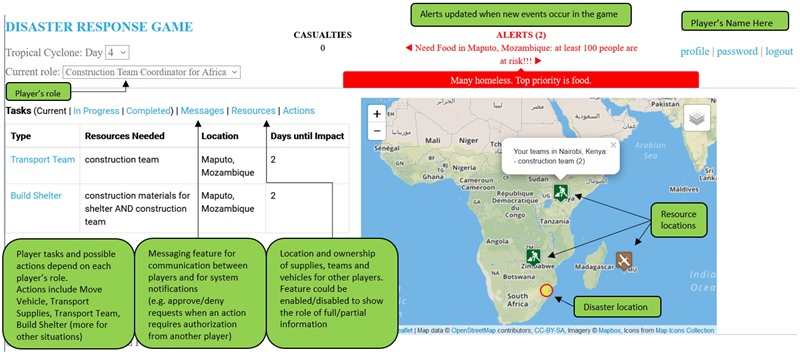
You hold one of four roles in a team responding to a tropical cyclone heading for southeastern Africa. You control some of what the response needs — construction supplies, construction teams, food and water, or the authority to approve every movement — but never all of it. Warnings arrive before the storm does, so you can move things into place early if you agree with the others where. The game runs one day at a time. Most actions take a full day, and handing a resource to another player is instant, so who owns what and when becomes the thing you argue about. When people need water, food, shelter or a clinic and your team is late, casualties appear in the header and keep climbing every day until you finish the job. The game ends when every task is done.
Our review
The part everyone owns a piece of
A good educational game that teaches the importance of working together, but server problems made it difficult to use with a whole class.
We could not play this game. The review below is based on official materials, other reviews and studies.
The Disaster Response Game is an online multiplayer game for teaching humanitarian logistics. It was built by Michael G. Klein of San José State University with Peter L. Jackson of the Singapore University of Technology and Design and Miho Mazereeuw of the MIT Urban Risk Lab, and described in a 2022 teaching brief in Decision Sciences Journal of Innovative Education, which is free to read. The game runs in a browser at disastergame.net and is currently available at no cost to faculty, subject to system capacity and an access request. The developer's own page also invites requests by email.
A full session runs about 90 minutes: ten minutes of introduction, a ten-minute demonstration, an optional fifteen-minute two-player tutorial, then roughly an hour for the main case. It can be split across two class periods or set as homework if a group can meet outside class.
What is it for?
It is aimed at undergraduate and graduate humanitarian logistics teaching and at training inside large organisations. The developers set out six learning objectives, and they are unusually concrete: that students can explain why coordination across stakeholders is needed, describe a response as a multistage plan, explain the value of prepositioning, identify their own mistakes and the casualties those caused, describe chains of dependency and find the critical path through them, and justify humanitarian priorities. They say plainly that the game is not enough on its own: it needs an instructor-led debrief and written reflection to reach those objectives. The game involves no data analysis or optimisation, and they suggest running it early in a course to motivate the modelling that comes later.
How do you play it?
The main case is modelled on Cyclone Idai, which hit Mozambique in March 2019. Four players hold the roles of Construction Supplies Manager, Construction Team Coordinator, Water and Food Supplies Manager, and Transportation Authority. The last of these must approve every vehicle movement and every transport of supplies or teams, which puts a deliberate bottleneck in the middle of the group.
Play advances one day at a time, moved on by the facilitator. Alerts announce events — a location needs water, food, shelter or a clinic — and each event generates tasks tied to particular roles. Miss a deadline and casualties appear, then compound daily until the task is finished. Most actions consume a whole day; transferring ownership of a resource to another player is immediate, which is what makes the early warning period useful. A map shows where everyone's resources sit, with animations for anything in transit, and a resource list shows what the other players hold. A messaging feature carries the negotiation.
Two design choices deserve naming. Delivering supplies is not the end of a task: a separate "Distribute Supplies" step exists because the developers wanted to teach the difference, citing the 20,000 bottles of water left on an unused runway in Puerto Rico after Hurricane Maria. And all journeys take exactly one day regardless of distance or vehicle, a simplification the developers made on purpose and which their expert reviewers asked them to remove.
Is it any good?
Yes, with a caveat about the server. The mechanics deliver the stated objectives rather than gesturing at them. Because no player holds a complete solution, a team that fails to talk delivers supplies with no team to distribute them, or a team with nothing to build with. Because casualties compound, a late decision keeps costing after it is made. The most instructive result the developers report is a group that built a shelter in the wrong place, could not build another because no spare materials existed, and watched casualties rise exponentially for the rest of the game. That is a better lesson than any slide.
The evidence is honest but limited. Eighty undergraduates in two sections of one course played it in Spring 2020, online during the pandemic. Their open comments were coded and reported, including the negative ones. Separately, researchers at the MIT Urban Risk Lab played it and rated it: 4.6 out of 5 for conveying the need to coordinate and for the value of prepositioning, 4.4 for chains of dependency, 4.2 for lead time — and 4.0, their lowest score, for realism. Students found the assigned roles valuable because they required collaboration, and the subject-matter experts rated the instructional design positively. All of this was collected as part of the development and teaching evaluation, from a small number of educational settings, with no control group and no test of what students actually retained. The expert ratings are judgements about the game's instructional design, not measurements of learning outcomes.
The reported weaknesses are real and worth planning around. The dominant student complaint was server speed: pages could take minutes to respond during classroom use, and the developers describe problems with the system under classroom traffic. Students also wanted written instructions rather than verbal ones, and a group broke down when a member missed a class, because there was no easy way to move that player's resources to someone else. A facilitator should confirm current server capacity before betting a class period on it, and should consider having groups play at staggered times.
What it leaves out
The coordination is entirely between responders. Affected people appear only as a casualty counter in the header. Nobody is consulted, nobody is informed, and no local organisation is at the table — the Africa case is played by four managers who are all outside it. This is worth noting because a recent systematic review of 65 humanitarian logistics and disaster-management games found community engagement to be one of the areas still underdeveloped in the literature. The gap is therefore not unique to this game, but it matters for a catalogue aimed at humanitarian practitioners.
The developers also removed a trade-off on purpose: they considered making players weigh cost against casualties and decided they were not comfortable putting that to undergraduates. That is a defensible teaching choice, and it is worth an instructor saying out loud that real responses do make it.
Game details
Core Humanitarian Standard alignment
Use fair, impartial and transparent criteria to define programmes and the people or groups supported by the organisation.
Players must decide which locations get scarce supplies and teams first, so a priority rule is unavoidable — but the only criterion the game rewards is the total casualty count, and it never asks who was left waiting.
Regularly monitor and adjust programmes to ensure actions are timely, accessible and address the priority needs of people and communities.
New alerts arrive each game day and missed deadlines produce casualties that compound until the task is finished, so plans have to be revised against a moving situation and lateness keeps costing after the fact.
Support local capacities to anticipate and reduce risks of potential crises or disasters.
Warnings arrive before the storm and the opening days carry alerts with no tasks attached, which exists to push players into moving resources into position ahead of impact — anticipatory action, though it is the responders' own capacity being positioned rather than anyone local.
Ensure the work of the organisation is coordinated with and complementary to locally led and community-based actions, and those of relevant stakeholders.
No player holds everything needed to complete a task, and one player must approve every movement, so the response only works if separate parties reach agreement, though the parties are all managers within one operation, and local or community-led actors are not among them.
Manage and use resources to achieve their intended purpose, minimising waste and the impact on the environment.
Transporting supplies to a location does not count as done; a separate distribution step is required, a mechanic the developers built specifically so players learn that supplies sitting undelivered help nobody.
Ready to use
Learning and teaching materials
- Teaching humanitarian logistics with the Disaster Response GameMichael G. Klein, Peter L. Jackson and Miho Mazereeuw · 2022 · Decision Sciences Journal of Innovative Education 20(3)
This study presents the Disaster Response Game, a multiplayer serious game designed to teach humanitarian logistics and disaster response decision-making. Students take on different roles and must collaborate to coordinate personnel and supplies during a simulated disaster, balancing limited resources while trying to minimize casualties. Testing with students and experts found the game realistic, engaging, and effective for teaching collaboration and disaster-response skills.
Sources
- Disaster Response Game — Official website
- Serious Games for Education and Training in the Humanitarian Sector: State of the Art — Academic publicationPragya Mukherjee and Emmanuel Guardiola · Cologne Game Lab