Catalogue record
HurricaneLog
Thiago Pereira, Daniel Aloise, Marie-Ève Rancourt, Danny Godin
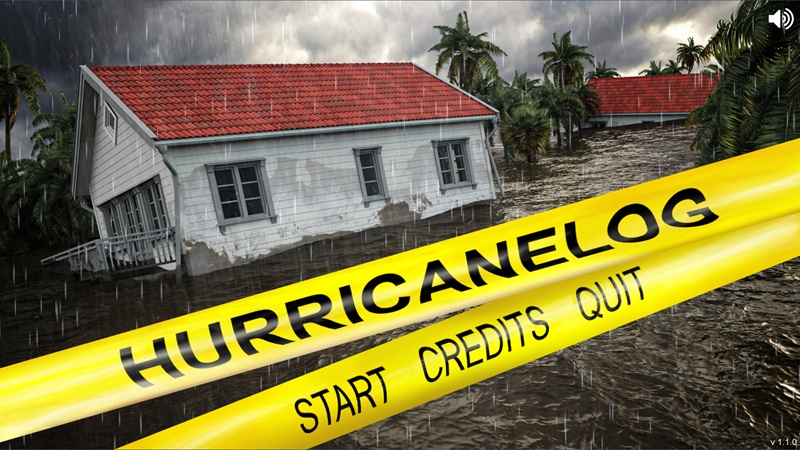
You work for a regional agency that handles disasters across four Caribbean islands. Before the hurricane season starts you get a budget. You decide how to spend it: buy relief supplies now and store them, improve a warehouse, upgrade a port, sign deals with suppliers or shipping companies, speed up customs, or pay for training and better communication. Each island is different, with its own population, wealth, risk level and quality of logistics. Then the season begins. Storms appear on the map, and you watch the forecast cones that show where each one might go. When an island is hit, people need food and family kits, and you decide what to send, from where, and whether by ship or by plane. At the end you see how many people you helped, how long they waited, and what it cost.
Our review
Deciding before the cone narrows
The best-grounded preparedness game in this catalogue, and the only one that makes prepositioning feel like a gamble. Note that it also collects your decisions for research.
- Learning value4/5
- Engagement4/5
- Sector realism4/5
- Accessibility2/5
HurricaneLog is a free desktop game about getting relief supplies to Caribbean islands before and during a hurricane season. It was built at Polytechnique Montréal by the PhD student Thiago Correia Pereira, supervised by Daniel Aloise there and Marie-Ève Rancourt at HEC Montréal. It was first described in a 2022 conference paper, written with Danny Godin of the Université du Québec en Abitibi-Témiscamingue, which is free to read and explains the whole game. A longer journal article followed on June 15, 2025, by the first three authors, reporting an experiment with 86 players.
You download it for Windows, macOS or Linux. There is no browser or mobile version. The interface is in English. The accessibility is a clear weakness of the game. In the cloud era there is no excuse for not having an online or a downloadable version from a reputable platform like Steam. Nobody will install an unsigned application when your device is screaming that it is not from a trusted source. That's a shame because the game has potential. The current download page does provide installers for all three desktop operating systems and asks players to use the tutorial or tutorial walkthrough before playing.
The developers do not state how long a game takes. Using their own figure — one hour in the game equals one second of real time, across a five-month season — a full season runs to about an hour, and you should plan on ninety minutes with the tutorial and the preparedness decisions. The developers ask you to watch a tutorial video or play the tutorial first.
What is it for?
Three uses, in the developers' own words: training for humanitarian logistics staff, a teaching tool for university supply chain courses, and awareness for people outside the sector. They want players to learn four things: that preparedness pays, that decisions must be made quickly, that each country needs a different answer, and that you must keep track of a situation while your budget is limited. The game's current research site still describes it as a training tool for humanitarian logistics agents and a complementary teaching tool for university students.
There is a 'hidden' fourth purpose. The game records what you decide, and also asks about your studies, your job and your gaming experience, so that researchers can compare strategies. That is why there is a consent form on the download page. Tell your group this before they play. Some organisations will need to check it against their own data rules. The 2025 study confirms that this research function is central rather than incidental: the authors collected in-game actions and participant background information to analyse decision-making strategies.
How do you play it?
The game has two phases. In the first, before any storm, you spend a fixed budget on eight kinds of investment: buying supplies in advance, better warehouses, better ports and airports, agreements with international suppliers, agreements with shipping companies, faster customs, better communication, and contingency plans and training. Some investments help one island, others help all four. Every option has a price, and you cannot buy them all.
In the second phase the season runs. Storms cross the map and you watch their forecast cones. The central decision is when to commit. Send supplies early by ship and they are cheap but slow, and wasted if the storm turns away. Wait until you are sure and send by plane, and they arrive in time but cost far more. There is no right answer, which is the point.
Four numbers follow you: how long people waited on average, how much you spent, how many people are in need, and how many supplies the region still needs. You can also move supplies between the islands instead of buying new ones. At the end you get a report showing your investments and how those four numbers moved.
Is it any good?
The groundwork is the strongest of any game in this catalogue. The storms are real Atlantic hurricane tracks, with forecast cones from the US National Hurricane Center. Damage is calculated using published models from peer-reviewed operations research, based on a country's population, its past hurricane losses and the storm's category. The island profiles come from real Caribbean countries. The eight investment options were taken from the research literature and from meetings with disaster risk management professionals. Very few games in this field can show that much of their working. The 2025 paper confirms that the simulation uses historical hurricane information and that its design was informed by disaster-management literature and consultation with professionals.
The design choice that makes it worth an hour is the forecast cone. Most preparedness teaching says prepositioning is good, then stops. This game makes you pay for it before you know whether you needed it, and then shows you the bill either way. Staff who have argued for a preparedness budget and lost will recognise the feeling immediately.
The limits are worth knowing. The islands are based on real countries but deliberately not named, so you cannot use the game to teach any specific place. Medicines were left out because they are complicated to model. The supply chain is simplified: once you decide to move something, four steps happen automatically, and how well they go depends on what you bought earlier. That is a sensible simplification, but it means the game teaches investment strategy, not the daily work of moving goods.
The newer research makes the simulation more interesting, rather than simply proving that it works. The 2025 experiment used the game with 86 participants from different backgrounds and captured their actual in-game decisions. The authors found distinct preparedness and response strategies, and found that a balanced preparedness approach — investing more in vulnerable, higher-risk islands and prepositioning resources — performed best in the simulation, meeting about 95 per cent of demand with a manageable increase in cost. This is evidence about the decisions the game produces and the strategies rewarded within its model, not evidence that players learned these strategies.
There is no independent evidence that anyone learns from it. The 2025 experiment with 86 players studied what strategies people chose and how those turned out. That is a real finding about decisions, but it is not a before-and-after test of learning, and it was run by the people who built the game. The study itself describes the game as an educational and analytical platform, but its experiment measures decision-making and performance rather than learning gains. Practically, the game is a desktop program you must download and install, in English, with a tutorial video to watch first, which is more work to set up than a browser game.
Who is it for?
Use it with logistics staff, preparedness teams and supply chain students, in a session of about ninety minutes, followed by a discussion of who committed early and who waited. It works best if several people play separately and then compare their reports. Do not use it as awareness material for a general audience, despite what the developers suggest — the investment list assumes you already know what prepositioning and customs clearance are. And do not use it without telling players that their decisions are being recorded.
Game details
Core Humanitarian Standard alignment
Use fair, impartial and transparent criteria to define programmes and the people or groups supported by the organisation.
Each island has its own population, national income, risk level and quality of logistics, and the game expects the player to treat them differently on that basis — so decisions rest on stated criteria about need and capacity, though the game never raises fairness between the islands as a question in itself.
Regularly monitor and adjust programmes to ensure actions are timely, accessible and address the priority needs of people and communities.
Storms are tracked through forecast cones that narrow over time, so the player must keep revising the plan as the picture changes, and the average waiting time of affected people is one of the four numbers used to judge them.
Support local capacities to anticipate and reduce risks of potential crises or disasters.
Preparedness is not a theme here, it is half the game: the player spends a fixed budget on warehouses, ports, supplier and shipping agreements, customs improvements, communication and contingency planning for each island before any storm arrives, and then watches those choices decide how well the response goes.
Ensure the work of the organisation is coordinated with and complementary to locally led and community-based actions, and those of relevant stakeholders.
The player acts for a regional agency covering four separate nations, and the game is built around moving supplies between them and setting up shared agreements with suppliers, shippers and customs, so cooperation between separate parties is how the response gets done rather than something happening in the background.
Use data from monitoring, feedback, complaints and learning to guide decision making, and to improve programmes and the organisation's ways of working.
Four indicators run throughout the season and a full report follows at the end, so the player can see which investments paid off and change approach next time. The link is loose: this is a player reviewing their own performance, not an organisation using monitoring data to change how it works.
Ensure adequate capacity and resources to meet the organisation's commitments.
Buying supplies in advance, improving warehouses and signing supplier agreements are all about having enough in place before the demand arrives, which is the practical form of making sure capacity matches what you have promised.
Manage and use resources to achieve their intended purpose, minimising waste and the impact on the environment.
Supplies sent to an island the storm then misses are simply lost, and total operating cost is scored alongside how many people were helped, which puts the cost of wasted effort directly in front of the player.
Sources
- Humanitarian Logistics Serious Game — Developer page
Official website
- HurricaneLog: A Serious Game for Data Collection and Analysis of Hurricane Preparedness and Response Operations — Other2024 · Cirrelt
Open full-text version of the research underpinning the 2025 journal article, including detailed methods, participant information and strategy findings.
- HurricaneLog: A humanitarian logistics game on hurricane preparedness and response operations — Academic publicationThiago Pereira, Daniel Aloise, Marie-Ève Rancourt, Danny Godin · 2022 · Proceedings of DiGRA
publication (open access) The complete mechanics: the two phases, all eight investment options, the four island profiles, the forecast cones, the four performance indicators, the relief items used, and the developers' four learning objectives. Also the time ratio used to estimate session length, and the authors' own account of what they simplified and why. Written by the developers, so the design intent is their claim.
- HurricaneLog: A serious game for data collection and analysis of hurricane preparedness and response operations — Academic publicationThiago Pereira, Daniel Aloise, Marie-Ève Rancourt · 2025 · International Journal of Disaster Risk Reduction 124
Peer-reviewed publication in June 2025, and an experiment with 86 participants reporting decision-making patterns and evidence on disaster management strategies. We read the abstract only. The study measures what players decided, not what they learned.