Catalogue record
Mission Zhobia
PeaceNexus Foundation, &Ranj
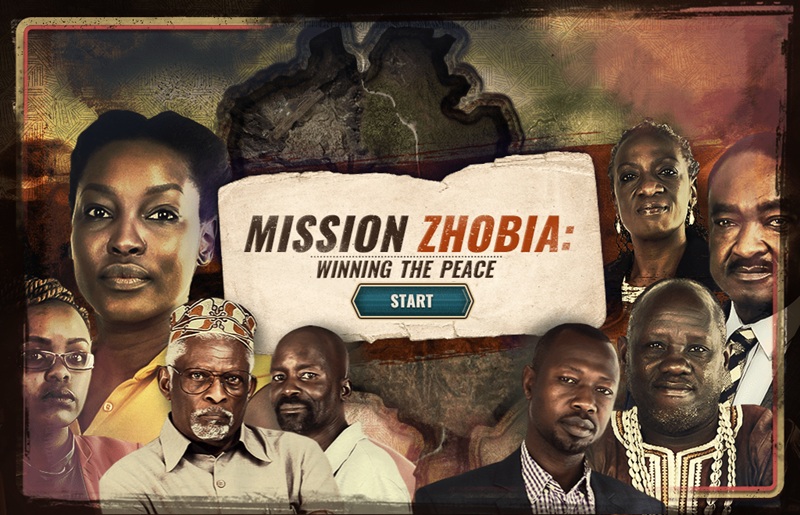
You play a project manager sent to Zhobia, a made-up country that has just come out of a violent conflict. Your job is to design a project that strengthens the justice system there, and the person who had the job before you already failed. You read briefings and local news, and you meet officials, community leaders and court staff, choosing what to say to each of them. Say the right thing and people trust you and tell you more. Say the wrong thing and they stop talking to you, and you do not get a second chance. At the end you decide where the courthouse should be built, what kind of justice system to support and who should be trained, then you hand in your plan and find out how well you read the country.
Our review
Where should the courthouse go?
A good game we have found for teaching people to listen before they decide, and a reminder that listening is not the same as being answerable.
- Learning value4/5
- Engagement3/5
- Sector realism4/5
- Accessibility2/5
Mission Zhobia: Winning the Peace is a free browser game in which you are flown into a country you have never seen, given a few weeks and a failed predecessor, and asked to write a rule-of-law project plan that will not make things worse. There is no map to conquer and no budget to spend. There are only people, and what they are willing to tell you.
It was initiated by the PeaceNexus Foundation with UNITAR, USIP, the Geneva Centre for Security Policy and ACCORD, who came together in 2013 to look for a new way to train peacebuilding skills, and built by the Rotterdam studio &ranj with support from the Creative Industries Fund NL. PeaceNexus says the consortium was formed in August 2013 and the game was developed as a web-based training tool for peacebuilding professionals. It launched in 2017. Individuals can play it for nothing; training institutes and other organisations using it as a learning tool are asked to contact the consortium about licensing, which is a sentence worth noticing before you build a course around it.
What is it for?
The target audience is mid-career professionals about to be deployed to a conflict-affected country, with everyone else invited along. The stated aim is narrow and sensible: people arrive in these jobs with strong technical expertise and very little practice at reading a political environment. The game lists five competencies it wants to build — analysing the context continuously, working out what different stakeholders actually want, building trust through dialogue, involving local people in finding the solution, and adjusting your plan as your understanding changes. In other words it is a game about conflict sensitivity, not about law.
That focus is also what makes it interesting as a serious game. Academic work on Mission Zhobia describes this kind of game as being particularly suited to skills development: the player has to practise dialogue, trust-building and perspective-taking rather than simply absorb information. The same research cautions that the scenario is necessarily a simplification of reality.
How do you play it?
It is mostly reading, clicking and choosing, thus do not expect anything that looks like a modern video game. You gather information from briefing documents, local media and messages on your phone, and above all from meetings. In a meeting you are offered three or four things you could say and you pick one. A good choice buys trust, more information and often an introduction to someone new. A bad one closes the person down for good.
Two things carry the teaching. The first is that you cannot simply decide what you think the answer is and then go looking for evidence to support it. The plan itself is assembled from choices you unlock by talking to people, so the quality of your final decision is set by the quality of your listening long before you make it. The second is that the game gives you a safe place to experience the pressure and uncertainty of peacebuilding without the real-world consequences. Academic analysis of the game describes this as one of its strengths: players experience competing arguments, emotions, trust and political consequences through the interactive dialogue.
Then you submit, and the game scores you on your understanding of the context, your handling of people, the perspectives you found, the trust you built and how far you changed your mind.
Is it any good?
There is more evidence behind this game than we initially gave it credit for, but not enough to claim that it has been proven to make people better peacebuilders.
A research project with with Christian Roth and &Ranj set out between 2020 and 2022 to test whether an interactive narrative like this actually trains better decisions than a story you simply read. The project is unusually candid about the problem it is trying to solve: serious games have often made plausible claims about learning without much empirical evidence behind them. The study therefore puts Mission Zhobia ahead of most of the sector in trying to test its learning claims, but it is still evidence of an evaluation effort rather than proof of effectiveness.
The underlying design is good. The game forces you to gather perspectives, build relationships and revise your assumptions rather than rewarding you for arriving with the right answer already in your head. Academic analysis likewise identifies the dialogue system and the ability to experience different perspectives and consequences as central to its learning potential.
What we liked less is that conversations work like keys. The plan you eventually submit is built from options that only appear once you have had the right conversation with the right person, thus you can know exactly what you want to propose and still not be allowed to propose it, because nobody has yet said the sentence that unlocks it. As a teaching device this makes sense, it is how the game forces you to consult before you decide. The side effect is that after one run the country can start feeling like a set of locked doors, and there is not much reason to go and open them again.
User research found that one participant specifically preferred Mission Zhobia because its solutions were not straightforward and made them think about how they would approach similar situations. The same participant said that this came with a cost: more time, more concentration and more reading than some other games.
Zhobia is also a generic fictional African country, thus it comes with all the usual problems of the generic fictional African country: no particular history, no real politics, a conflict assembled from spare parts. That is partly unavoidable in a training scenario, and the academic literature explicitly recognises the trade-off: a serious-game scenario has to simplify reality enough that a player can actually process it.
Then there is the look of it. Our first reaction was that somebody was joking, the styling, the acting and the staging land somewhere near a low-budget straight-to-video drama, and the effect is hard to sit through without wincing. Some of that must be deliberate. A training game needs characters you can read in two seconds, the impatient boss, the smooth official, the community leader who has heard promises before, and broad playing delivers that fast and cheaply.
Harder to defend is what sits behind it: you are the outsider flown in, your boss is a manager somewhere far away, and the Zhobians are the people you have to handle to get your plan approved. That is a real and recognisable picture of how this work is often staffed, but the game presents it as simply the way things are, and never once invites you to find it strange. Academic writing on serious games makes the broader point that these simulations are inevitably shaped by what they choose to represent and what they leave out. Mission Zhobia is useful precisely because it lets us experience the outsider's position, but that position is itself something worth questioning.
Notice what it scores you on
This is the part worth arguing about. The game rewards you for finding more perspectives, building trust and changing your plan once you have heard something new. That is a good message and the opposite of how a lot of project design actually happens.
Nonetheless, look at where the marks come from. They come from the designers. The Zhobians you met do not get to see your plan and cannot object to it. Their role is to give you information and, if you handled them well, to open an option you did not have before. Once you submit, the game tells you how you did.
That is the difference between consulting people and being answerable to them. Consultation means you listened and then decided. Accountability means the people affected can see what you decided, say that it is wrong, and have that go somewhere, which is what frameworks like the Core Humanitarian Standard treat as a requirement rather than good practice. Mission Zhobia teaches the first well. It cannot teach the second, because a single player game that ends when you hand in your homework has nowhere to put a complaint.
This is not necessarily a failure against the game's stated objectives: it was designed to teach context analysis, stakeholder perspectives, trust, engagement and adaptation. But it is an important limit on what we should claim for it.
It also comes on its own. There are no discussion questions for a trainer, no exercises and no reading list, and PeaceNexus answered at the time that consortium members are training institutes and would build their own material around it. Fair enough if you are one of them. If you are a small NGO that found the game online, the teaching part is your problem, thus budget an hour for the discussion afterwards. The question we would put to the room is this: who in Zhobia should have been able to stop you, and what would they have had to do?
As professional training it holds up, provided somebody runs the debrief. As a game you will see the ceiling in one sitting. As a portrait of the job it is uncomfortably accurate about the half it covers.
Game details
Core Humanitarian Standard alignment
Ensure diversity, equity and inclusion considerations are integrated into the organisation's work with people and communities, with attention to the most marginalised.
You are rewarded for finding perspectives that are easy to miss, without any framing of inclusion or marginalisation.
Ensure people's participation in decisions and actions is meaningful for them and corresponds to their preferred ways of engaging.
The meetings are the game's core mechanic and you are scored on how meaningfully you brought people into a decision that affects them.
Plan and implement programmes which respect and build upon local knowledge, capacities and existing actions.
The central choice is whether to build the project on the justice mechanisms Zhobians already use or to impose a new structure over them.
Establish a coherent organisational approach to ensure support is based on an understanding of the context and culture and the diverse capacities, vulnerabilities, needs and risks faced by people and communities, with attention to the most marginalised.
Ongoing context and conflict analysis is the first competency the game claims to build and the first thing it marks you on.
Support local ownership of resources and decision making from the outset of work with people and communities.
Local ownership shows up in what stakeholders ask of you, but the decision stays yours throughout.
Identify, prevent, mitigate and address potential and actual negative impacts of programmes on people and communities.
The stated aim is engaging in a more conflict-sensitive way, which is do-no-harm under another name, though harm is never assessed as such.
Ensure the work of the organisation is coordinated with and complementary to locally led and community-based actions, and those of relevant stakeholders.
Backing existing local mechanisms rather than duplicating them is complementarity in practice, though the game frames it as programme design.
Use data from monitoring, feedback, complaints and learning to guide decision making, and to improve programmes and the organisation's ways of working.
You are scored for revisiting your plan as your analysis changes, but this happens before the decision and draws on no feedback afterwards.
Sources
- Managing Expectations? The Opportunities and Limitations of e-Learning Applications in Conflict Prevention and Peacebuilding Training — Academic publicationLeila Demarest and Róisín Smith · 2019 · Journal of Peacebuilding and Development
This study examines the use of e-learning and serious games for training staff in conflict prevention and peacebuilding. While these tools have limitations in developing skills and knowledge, they face challenges similar to traditional classroom training. The study concludes that digital tools can still expand access to training and professional development, especially for non-Western participants.
- Mission Zhobia: Validating a Narrative Game for Complexity — OtherDr. Christian Roth and &ranj Serious Games · 2022 · Userly.Tech
This study examines whether narrative serious games can help people understand complex issues and make better decisions. Using Mission: Zhobia, it investigates whether interactive storytelling is more effective than non-interactive narratives for learning in complex environments. The research aims to provide evidence on how serious games and specific design features can improve learning and training.
- Official website — Official website
- Review: Mission Zhobia — OtherRex Brynen · 2017 · PAXsims
This blog post reviews Mission Zhobia, a free online serious game designed to develop peacebuilding skills for people working in conflict-affected areas. Players take the role of a project manager in the fictional country of Zhobia, where they research the context, engage with local stakeholders, build trust, and make decisions about a rule-of-law project. The review highlights the game’s engaging and realistic decision-making, while noting that it would benefit from stronger guidance for debriefing and integrating the game into broader teaching
- Serious Games: Humanitarian User Research — OtherMatthew R. Stevens, Brianna Proceviat, Thomas Fisher, Catherine Benedict, Alejandra Espinosa, Johanna Reynolds and Sterling Perkins · 2020
This report and the research which informs it are intended to explore the potential applicability of serious games and games-based learning to the humanitarian sector, particularly in the context of localization. Serious games are increasingly being adopted as training tools in other fields, but have seen slow adoption in the humanitarian sector