Catalogue record
Outbreak READY!
Save the Children, Johns Hopkins Center for Humanitarian Health, Johns Hopkins Center for Communication Programs, UK-Med , Humanitarian Leadership Academy, &RANJ, USAID
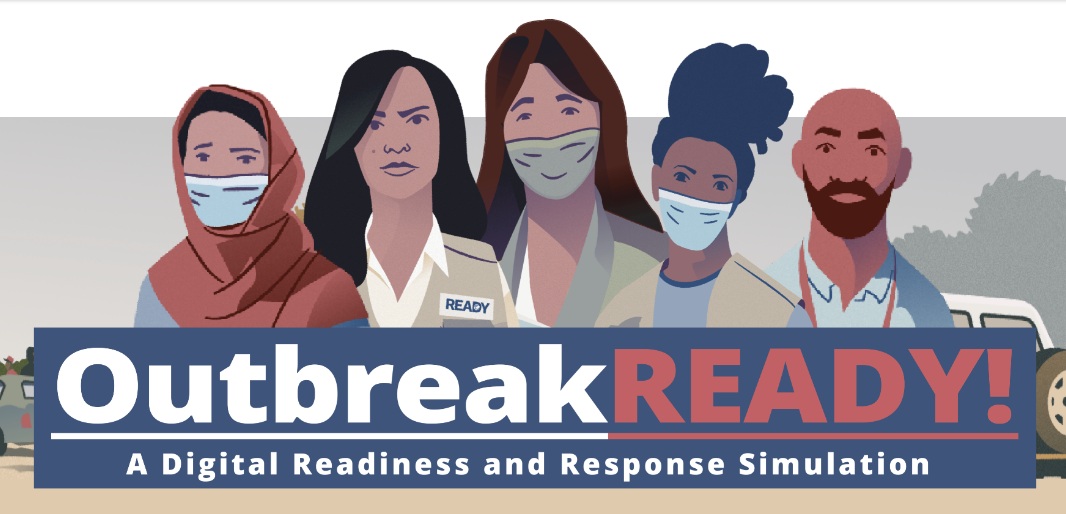
You play a team lead at READY, a fictional medium-sized international NGO working in Thisland, a fictional low-income country recovering from civil conflict after a disputed election. The simulation runs in two modules. First, you decide what readiness measures to fund and prioritise while an outbreak is detected in a neighbouring country. Then, as the outbreak reaches Thisland, you adapt and expand READY's multi-sectoral programmes in response. Throughout the simulation, you read emails, briefing files and assessment data, and talk with your country director, national staff, public health officials, a partner NGO, a journalist and a community leader, choosing between set options at each turn. The simulation ends once you make your final response decisions in the second module; a facilitator or the Solo-Play Guide then leads you through reflecting on the choices you made.
Our review
A very realistic training simulation with not much of a game
Outbreak READY! is clearly aimed at humanitarian professionals rather than the general public. It has strong sector realism and useful decision-making practice, but the game layer is thin, the pace is slow and the fun is mostly what you get from making a good management decision.
- Learning value4/5
- Engagement2/5
- Sector realism5/5
- Accessibility4/5
Outbreak READY! is a free, browser-based simulation about preparing for and responding to an infectious disease outbreak in a humanitarian setting. You play a team lead at a fictional international NGO called READY, working in Thisland, a fictional low-income country marked by recent civil conflict and displacement. It was released in 2022 and won a bronze International Serious Play Award that June. We had to think about whether this should really be called a game. There are choices, time limits, budgets and consequences, but there are not many game mechanics in the usual sense, and the enjoyment level is low. A lot of the experience is effectively managing a humanitarian response: reading reports, opening documents, checking data, answering messages and then deciding what to do next. If this is your actual work, you might reasonably ask whether you really need more of it after hours. Where is the fun in doing the same stuff as work?
That is also the point of the simulation. The developers made it for NGO leaders and managers, and describe it as a digital training tool for humanitarian professionals rather than a game for general entertainment. READY calls it a computer-based serious game, while Rex Brynen, one of the designers, says it is “more of a simulation than it is a game” and that it is aimed at experienced humanitarian workers.
So the lack of fun is partly a design choice. This is trying to reproduce the kind of decisions humanitarian managers actually make, including incomplete information, competing priorities, coordination problems and the slow arrival of results. The official site even collects comments from players saying it felt like “the daily challenges in my work” and an “exact translation of reality”. That is almost the perfect compliment for realism, although perhaps not for a Friday night entertainment product.
What is it for?
Outbreak READY! was created to strengthen the operational readiness of national and international NGOs preparing for large infectious disease outbreaks in humanitarian settings. It is aimed particularly at NGO leaders and managers from both operational and programme backgrounds, across sectors rather than only health specialists.
Its learning goals are practical: understanding outbreak readiness, making trade-offs about limited resources, identifying important stakeholders and coordination structures, understanding how different sectors contribute to a response, and using epidemiological, assessment and community feedback data to adapt programmes. It is not clinical training and does not try to model disease transmission in a way that lets players experiment with an epidemic.
How do you play it?
The simulation has two modules. In the first, an outbreak is detected in a neighbouring country and you decide which preparedness measures to prioritise and fund. In the second, the outbreak reaches Thisland and you must adapt and expand READY's programmes. The main mechanic is reading information and making decisions from it. You receive emails, reports, briefing documents and assessment data and speak to different people involved in the response. You then select from a set of options. The game gives you limited time, and some decisions affect later parts of the simulation.
This is much more about judgement than control. You are not building a hospital, moving units around a map or watching an epidemic spread in real time. You are trying to decide what a humanitarian team should do with limited information and resources. The simulation can be played alone or as a facilitated group exercise, either in person or online. The developers provide substantial pre-reading, a solo-play guide and facilitation manuals. This is important because a lot of the learning comes from explaining why you made a particular decision and comparing it with other people's choices.
Is it any good?
As a training simulation, there is a lot to like. The sector realism is high, and the decisions feel connected to actual humanitarian management rather than to a simplified version of it. You are constantly balancing priorities, resources, coordination and changing information. The downside is that the simulation sometimes feels less like playing a game and more like doing your job in a slightly more colourful browser window. There is a lot of reading and relatively little in the way of traditional game reward, exploration or discovery. The choices are also fixed, so you are practising how to assess a set of options rather than inventing your own response.
The slow feedback is more defensible. In a real outbreak, an individual NGO does not normally get immediate evidence showing that one decision caused one specific epidemiological result. Because the NGO is only one actor in a wider response, the simulation deliberately avoids pretending that every decision produces a neat instant result. Brynen makes the same point in his discussion of the design.
There is also clear evidence that a great deal of work went into making the simulation realistic. The developers say the content was developed with many subject-matter experts and went through user testing. The independent 2024 READY II final evaluation describes the simulations as realistic and powerful learning tools, with participants saying they reflected real-life outbreak situations. In its survey, 84% of respondents said their knowledge had increased and that they felt better equipped to support their organisations during outbreaks.
That evidence needs some caution. The evaluation covered the wider READY initiative, and the simulation findings were based largely on participant feedback rather than a controlled test of learning. The evaluation itself says its methodology did not use a counterfactual and focused on experiences, perceptions and self-reported changes. So we can say that users reported learning and increased confidence, but not that the simulation has been independently proven to improve professional performance. The same evaluation found that Outbreak READY! had been used in 100 countries, and that some potential users in low- and middle-income countries could not play because of internet limitations. It also records that an offline version existed but was difficult to distribute because of the size of the file.
Interestingly, the evaluation describes the simulations as a successful example of gamification of capacity strengthening, and says the experience helped encourage other organisations, including WHO/GOARN, to explore similar approaches. That is probably the fairest way to think about Outbreak READY!: it is not a great game pretending to be training. It is good training with a game layer added to make the training more active.
Who should use it, and for what?
This is for humanitarian professionals, especially NGO managers and people responsible for preparedness and outbreak response. It can also work well in universities and other professional training settings, particularly when there is time for group discussion.
It is not really a game for the general public. It is a serious training simulation that borrows some elements from games. Its value comes from realism, decision-making and discussion rather than fun. In that sense, the developers have largely achieved what they set out to do. The slightly unfortunate side effect is that the better it succeeds at feeling like humanitarian management, the less you may feel like playing it after a day at work.
Game details
Core Humanitarian Standard alignment
Ensure people's participation in decisions and actions is meaningful for them and corresponds to their preferred ways of engaging.
The publisher describes the aim as community-centred decision making, and the player meets a community leader and reviews community feedback data when planning the response.
Regularly monitor and adjust programmes to ensure actions are timely, accessible and address the priority needs of people and communities.
The second module requires the player to adapt and expand the NGO's programmes as the outbreak spreads, using new assessment information. That is the practice of monitoring a programme and adjusting it so support stays timely and matches changing priority needs.
Ensure the work of the organisation is coordinated with and complementary to locally led and community-based actions, and those of relevant stakeholders.
A stated learning objective asks the player to identify the stakeholders and coordination structures that matter in an outbreak response and to weigh how they affect multi-sectoral activities. In play you deal with public health officials, a partner NGO and your own country office, so decisions have to fit alongside what other responders are doing.
Use data from monitoring, feedback, complaints and learning to guide decision making, and to improve programmes and the organisation's ways of working.
A stated learning objective asks the player to use epidemiological, assessment and community feedback data to develop adaptive management strategies and response plans. The game supplies these data through emails and files, and the player must read them and let them change the plan.
Ensure adequate capacity and resources to meet the organisation's commitments.
The first module is about operational readiness: which preparedness investments to make before the outbreak arrives, and what each one costs in money, staff time and attention. The player sees how those capacity and resource decisions constrain what the organisation can later deliver.
Sources
- Outbreak READY! A Digital Readiness and Response Simulation — Official websiteREADY initiative
Official website of the game.
- Outbreak READY! Simulations: Overview — Developer pageJohns Hopkins Center for Humanitarian Health
The co-developing organisation's resource page.
- Outbreak READY! infectious disease simulation — News / mediaRex Brynen · 2022 · PAXsims
A review of the game by one of its contributors, Rex Brynen.
- READY II Final Evaluation — OtherAmelia Goldsmith, Claire Weil · 2024
Independent 2024 endline evaluation.