Catalogue record
Path Out
Causa Creations, Abdullah Karam
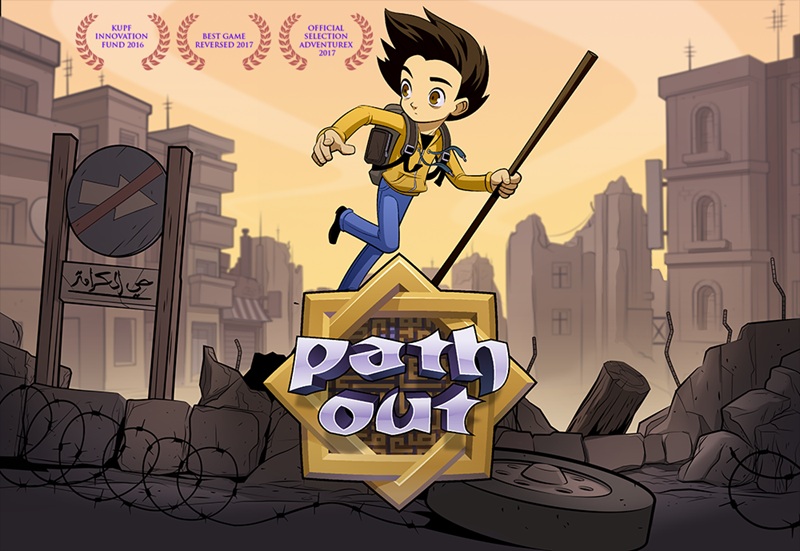
You play a teenage boy in Hama, Syria, in 2014. The game looks like an old 16-bit role-playing game. You walk around pixel streets, talk to your family, and do small tasks. Then the war comes closer. Your family decides you have to leave. The same small world now becomes a road north, through Aleppo province, towards the Turkish border. You pass checkpoints and soldiers. You cross a minefield, and you must look carefully before every step. There is no fighting in this game. You walk, you talk, and you stay out of trouble. From time to time a video opens in the corner of the screen. The real person whose escape this is speaks straight to you. He explains what the game left out. He jokes about his own bad choices. The story stops at the Turkish border.
Our review
Meeting your game hero
A refugee game where the real person talks back to it. Good for awareness, but it shows no aid work at all.
- Learning value4/5
- Engagement3/5
- Sector realism1/5
- Accessibility4/5
Path Out is a game about one real escape from Syria in 2014. It was made by Jack Gutmann. He made it and narrated it under his earlier name, Abdullah Karam, and that is still the name on most listings and on the character you move. He worked with the Vienna studio Causa Creations, the composer Wobblersound and the designer Brian Main. Public money from Austria paid for it: the Kupf Innovation Fund, the Federal Chancellery, the Vienna Business Agency and the city of Salzburg. It came out in 2017 and takes about two hours. It is free on Steam for Windows and macOS but you can also download it from the official website.
If you want to run a session, use the other version. Causa Creations and UNHCR made a shorter classroom edition. It runs in a web browser, so nobody has to install anything. It fits into one lesson. It has subtitles in German, Norwegian, Swedish and Finnish as well as English. UNHCR also gives away lesson plans for ages 12 to 15 and ages 15 to 18. No other game in this catalogue is this easy to put in front of a group.
What is it for?
Awareness and school teaching. Not professional training. The aim is to let you follow one real journey and meet the person who made it. UNHCR uses it so that pupils who may never meet a refugee can see that this one lived much like they do, until his life was turned upside down. There are no learning outcomes about humanitarian work, because the game is not about humanitarian work.
How do you play it?
It is made in RPG Maker and it looks like a classic Japanese role-playing game. You move a character around simple maps, talk to people, and do small quests. Then the same simple actions become dangerous. Walking around your home town is harmless. Walking in a minefield is not. Soldiers are people to escape, not to fight. There is no combat at all, which is clearly on purpose.
The videos are the important part. Every so often the author appears in a corner of the screen and talks over his own game. He gives context and sometimes jokes around.
Is it any good?
Yes, and the reason is who made it. Most games about displacement are made about someone by other people. This one was made by the person it is about, and it is built so that he can stop and correct any moment where the game gets him wrong. Our sector talks a lot about who gets to tell the story. Here that question is answered in the design.
It has done well. It won many festival and industry awards, it sits in the NTT InterCommunication Center archive in Tokyo next to Papers, Please, and its Steam reviews have stayed around 90 per cent positive across nearly two hundred of them.
There are clear limits. This is one episode. Up to five were planned, following the journey through Turkey, Greece and the Balkans to Austria. Nothing more has appeared in nine years. So the story stops at the Turkish border, and your session will end in the middle of the journey. Tell people that before they start. There is also no study of what players learn, so the UNHCR lesson plans do that job, not any evidence. And there is no Arabic. A game by a Syrian, about Syria, is available in various languages and not in his own.
The biggest limit for this catalogue is simple. No aid worker appears. No agency, no camp, no registration, no protection officer. There is only a person, a family decision and a road. That is true to the story being told. It also means you will learn nothing here about how a response works, and a lot about what it feels like to be outside one.
Who is it for?
Use the classroom edition with the UNHCR lesson plan for induction, school work and awareness sessions. Use the full Steam version for a longer session or to prepare on your own. Do not use it to teach response, protection procedures, or anything an aid organisation actually does.
Game details
Core Humanitarian Standard alignment
No Core Humanitarian Standard requirements are mapped for this record. No organisational practice is depicted, so any mapping would be inference by analogy rather than evidence.
Ready to use
Learning and teaching materials
- UNHCR teaching materials
Children will learn the dangerous situations in which many refugees live and find out about reasons to flee. They will also learn about the dangerous journeys many refugees need to undertake to get to safety. They will also learn about the difficult choices families need to make when they are forced to flee.
Sources
- Causa Creations — Official website
Official website of the developer
- Steam — App store
Official store page on Steam