Catalogue record
STOP DISASTERS!
United Nations Office for Disaster Risk Reduction (UNDRR), Playerthree
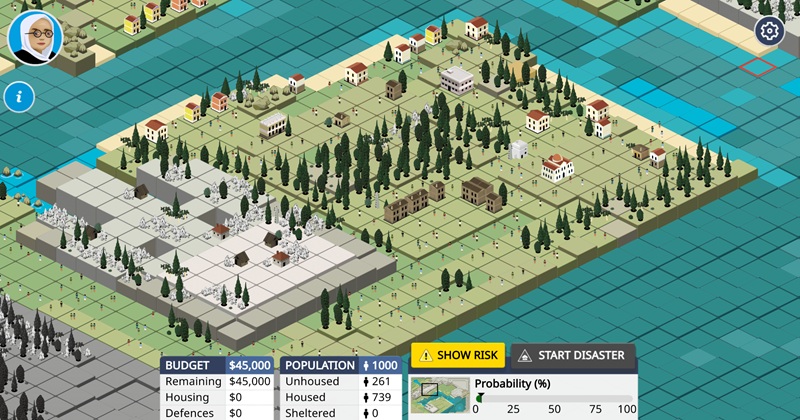
You get to be in charge of preparing a community for different natural disasters, like earthquakes, floods, tsunamis, wildfires, and hurricanes. You have limited time and resources, so you need to decide where to build things, how to protect people, and what safety measures to put in place. The goal is to make your community as safe and prepared as possible before the disaster hits.
Our review
You have a budget, a countdown and an incoming hurricane…
A bit dated but still worth twenty minutes of anyone's training day, as long as someone runs the discussion afterwards.
- Learning value3/5
- Engagement3/5
- Sector realism3/5
- Accessibility5/5
Stop Disasters! is a free browser game from the UN Office for Disaster Risk Reduction that drops you onto a grid-based map with a budget, a countdown and an incoming hazard, and asks how many people you can keep alive. It is probably the best known game our sector has ever produced, which says as much about the sector as about the game.
It was built in 2007 by the London studio Playerthree for what was then UNISDR, as part of the World Disaster Reduction Campaign "Disaster Risk Reduction Begins at School". Originally a Flash game, it was rebuilt in HTML5 once Flash was retired, and UNDRR has kept commissioning translations since — seventeen languages at the last count, plus mobile support and an offline install. Most agency games quietly disappeared with Flash, thus nineteen years of continuous maintenance on a communications product is not something we do often.
What is it for?
The audience is 9–17-year-olds, as well as classrooms, workshops and professional training settings. The learning outcomes are intentionally modest and specific: where you build, and how you build, can change the impact of a hazard; and early warning systems, evacuation plans and education can save lives. Underpinning these lessons is the campaign line the agency has repeated for two decades: there is no such thing as a natural disaster — disasters occur when hazards meet human decisions.
How do you play it?
Five scenarios — flood, earthquake, tsunami, wildfire, hurricane — each at three difficulty levels, each ten to twenty minutes. Everything is point and click. You house a set number of people, put up a school or a hospital, sometimes build hotels to keep the local economy going, and spend what is left on defences, warning systems and training. Then the hazard arrives and you get a damage report telling you how many people you killed.
Two mechanics carry the teaching. Clicking objects surfaces short factual tooltips, and collecting them earns points. Better are the advisers, who appear mid-game with suggestions that are sometimes sound and sometimes exactly what a hotel developer would tell you. Working out which voice to trust is the closest the game gets to real decision making.
Is it any good?
Some say yes, but others are a bit more skeptical. An ISCRAM experiment with children in Rio de Janeiro found most could explain what a risk map is afterwards, and a comparative study in NHESS credits the budget constraint with pushing players into genuinely evaluative thinking. More recent research with preservice geography teachers found moderate-to-high engagement and strong recognition of the game's value for teaching preparedness, but much lower ratings for realism and regional relevance. While a design analysis at WPI, of the older Flash build, calls it a good idea poorly executed: the useful information appears only after you have acted, and the game rarely tells you when you got something wrong. A Humanitarian Futures case study makes a different point, that the game is rigid about which choices count as correct, and that players might come away thinking a community is safe once the right list of measures has been bought. Residual risk is a hard idea to teach and the game does not really try. The newer research makes the wider problem clearer: the game's simplification of hazard mechanisms, geography and regional context can limit what players actually learn from it.
Personally, what we didn’t really like is that there’s no trade-off for building essential infrastructure, like schools and hospitals, at remote, high-elevation locations. You can keep building anything on high terrain without facing any real penalty or downside. That is not just a minor game-design quirk: it is an example of the wider problem with the simulation, where a simplified map can make a risk-reduction decision look more straightforward than it would be in a real community.
The game seems to work better with a discussion built around it than on its own. The same case study suggests giving each player a role — town planner, head teacher, doctor, fisherman, hotel owner — so that the disagreements about what to spend the budget on happen out loud, and then setting aside twenty minutes or so at the end to go through what people chose and why. More recent research reaches much the same conclusion: the game's strongest educational use depends on teacher scaffolding, contextualisation and guided reflection rather than treating the simulation as a complete lesson.
As a classroom tool it holds up. As professional training it works as an icebreaker rather than a curriculum. As a game you will probably see the ceiling within three scenarios, which is still more than can be said for most of what the sector has produced.
Game details
Core Humanitarian Standard alignment
Use fair, impartial and transparent criteria to define programmes and the people or groups supported by the organisation.
Deciding who gets protected first when the budget will not cover everyone.
Apply relevant technical standards and recognised good practice in the organisation's work with people and communities.
Paying more for construction that survives the hazard, and learning why it does.
Establish a coherent organisational approach to ensure support is based on an understanding of the context and culture and the diverse capacities, vulnerabilities, needs and risks faced by people and communities, with attention to the most marginalised.
Risk mapping and hazard-specific vulnerability; the Rio study found children could explain a risk map afterwards.
Support formal and informal community leadership and locally led efforts to reinforce the resilience of people and communities.
Adviser characters stand in for local voices, though none of them leads anything.
Support local capacities to anticipate and reduce risks of potential crises or disasters.
Preparedness and risk-reduction decisions and capacity-building elements are included in the game.
Plan and implement programmes that contribute to long-term positive effects on people's lives, livelihoods, the local economy and the environment.
Environmental, ecosystem related and long-term risk decisions need to be made
Manage and use resources to achieve their intended purpose, minimising waste and the impact on the environment.
Fixed budget against competing protective measures and resource allocation is the game's core constraint.
Ready to use
Learning and teaching materials
- Lesson plans and supporting material
This page brings together ready-to-use lesson plans, classroom activities, and teaching guides for the Stop Disasters online simulation game, developed by the UN Office for Disaster Risk Reduction (UNDRR).
- Stop Disasters for TeachersUNDRR
UNDRR has a dedicated teacher page bringing together the game's learning sequence, tutorial, factsheets and additional lesson plans. It explicitly says these resources are intended to incorporate the Stop Disasters game into teaching.
- Teaching resilience with the Stop Disasters game: a teacher's guideUNDRR
This is an official UNDRR Teacher’s Pack specifically created for STOP DISASTERS! It contains a classroom-ready learning sequence, a gameplay tutorial, hazard factsheets, glossary, and posters.
Sources
- Case Study 16: UNISDR “Stop Disaster” Game — OtherUnited Nations International Strategy for Disaster Reduction · 2015
This case study is about using the Stop Disasters computer game as a tool for disaster risk reduction education and community decision-making. Players work individually or in teams to prepare a community for hazards such as floods, earthquakes, hurricanes, tsunamis, and wildfires by making decisions within a limited budget. The case study highlights how the game can promote discussion, negotiation, awareness of community vulnerabilities, and understanding of disaster preparedness, while also noting limitations such as oversimplified “right and wrong” solutions and limited adaptation to local contexts.
- How to Communicate and Educate More Effectively on Matural Risk Issues to Improve Disaster Risk Management Through Serious Games — Academic publicationMercedes Vázquez-Vílchez, Rocío Carmona-Molero, and Tania Ouariachi-Peralta · 2025 · Natural Hazards and Earth System Sciences 25(10)
This study examines how serious games can improve disaster risk management by analyzing six digital games and surveying experts about effective game design. It finds that online games provide stronger educational content, while mobile games offer more interaction and playfulness. The study recommends focusing on characters, information and messaging, narrative, rewards, and feedback when designing games to improve disaster risk awareness.
- Official Website — Official website
- Playerthree — Developer page
Website of the developer
- Stop Disasters Game Experiment with Elementary School Students in Rio de Janeiro: Building Safety Culture — Academic publicationSoraia Felicio, Viviane S. R. Silva, André Dargains, Paulo Roberto Azevedo Souza, Felippe Sampaio, Paulo Victor R. de Carvalho, José Orlando Gomes, and Marcos R. S. Borges. · 2014 · Proceedings of the 11th International ISCRAM Conferencw
This study examines whether the Stop Disasters game can improve disaster awareness and resilience among school students in Rio de Janeiro. Students aged 10–13 played the flood scenario and completed questionnaires before and after the game, with results showing increased understanding of disaster risks and concepts such as risk maps. The study concludes that serious games can be effective tools for raising awareness and teaching children how to respond to disasters, although improvements to the game’s graphics, missions, controls, and feedback were recommended.
- Stop Disasters Game as a Tool for Teaching Resilience within Geography Education in Uncertain Times — Academic publicationEmmanuel Eze and Rainer Mehre · 2026 · European Journal of Geography 17(2)
This study explores how the Stop Disasters serious game can teach disaster preparedness to future geography teachers. While participants found the game engaging and useful, they criticized its realism, regional relevance, and ability to challenge assumptions. The study concludes that serious games are useful educational tools but require additional guidance, realism, and contextual adaptation.
- Stop Disasters! Serious Game Analysis for IMGD 4600 — OtherDaniel Acito and Caitlin Malon · 2007 · Worchester Polytechnic Institute
This case study analyzes Stop Disasters!, a resource-management game designed to teach disaster preparedness and risk reduction. Players manage limited time and money to strengthen communities, build defenses, train residents, and install warning systems before a disaster occurs. The analysis finds that while the game provides useful disaster-related information and decision-making opportunities, its limited realism, weak feedback, repetitive gameplay, and interface issues reduce its effectiveness as a learning tool.