Catalogue record
World Rescue
Pocket Scientists, ZU Digital, Literary Safari, UNESCO MGIEP
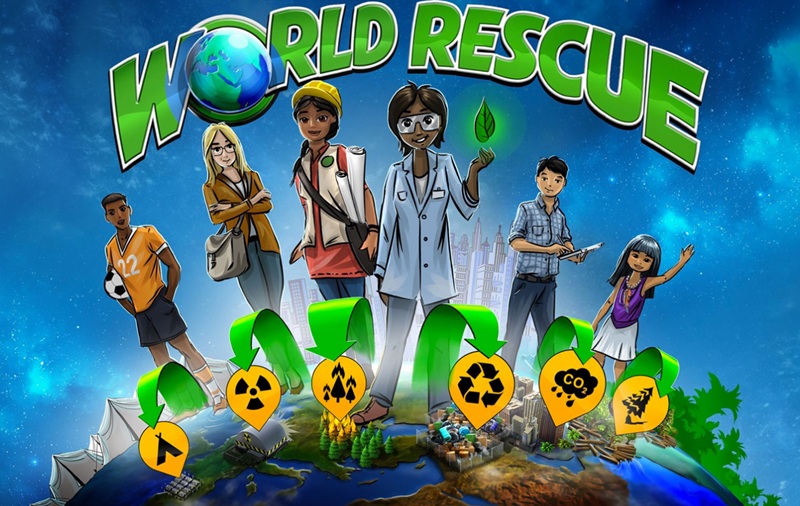
A mobile game for children about the Sustainable Development Goals of the United Nations. You follow five young people in five countries — Kenya, Norway, Brazil, India and China — and each of them faces a different problem in their own community: people forced to leave their homes, a disease outbreak, forests being cut down, a drought, and polluted air and water. You help them by playing short mini-games with your finger: puzzles, quizzes, sorting tasks and simple planning tasks, most of them under a time limit. A professor character explains what the problem is and why it matters. The idea behind the game is "think globally, act locally": the problems are global, but you solve them in one village, one town or one factory at a time.
Our review
What happens when the funding ends
A good idea from 2017 that the United Nations still links to, even though the game is no longer in the app stores
We could not play this game. The review below is based on official materials, other reviews and studies.
World Rescue came out of a competition. In 2014 UNESCO MGIEP, a UNESCO institute based in New Delhi, asked people to send in designs for video games about peace, sustainability and global citizenship. It received 104 entries from 36 countries. In October 2015 it picked World Rescue, and the team that had sent it in, the Hungarian studio Pocket Scientists, was given funding and mentoring to build it.
The game was planned for late 2016 and arrived in 2017, published by ZU Digital with the story written by Literary Safari in New York. It was free, it was made for Android and iOS, and it had five characters, five countries and nine mini-games.
Today the game is no longer available on the main app stores, and the developer says it is looking for supporters to bring it back. The UNRIC page, which the United Nations updated in February 2025, still says the game is available on Android and iOS, and still links to a website where the download buttons no longer lead anywhere useful. Eleven years after the competition, a UN body is still recommending a game that a teacher cannot obtain. To be fair the developers are looking for supporters to help bring back the game, making it available for everyone once again — on a non-profit basis.
What is it for?
The audience is children, roughly from primary school to early secondary. The aim is awareness: the player should finish knowing that displacement, disease, deforestation, drought and pollution exist, that they are connected to the Sustainable Development Goals, and that ordinary people in the affected places are already working on them.
The last part is the best decision in the design. The five heroes are local: an African health worker, an Indian agricultural scientist, a Brazilian girl protecting the forest. Nobody flies in to save anyone. For a game funded by a UN institute, that is a more careful choice than it may sound, and most games of this kind do the opposite.
How do you play it?
You tap and drag. Each chapter gives you a short mini-game with a time limit, and finishing it moves the story forward. Between the mini-games a professor character talks to the young heroes and explains the background.
Common Sense Media, which reviews apps for parents and teachers, described the structure clearly and noted three problems: the time limits frustrate younger children, the game advertises the developer's other games inside it, and some of the content — war, refugee camps, extreme weather — can frighten children who are not ready for it.
Is it any good?
We cannot give you a fair answer about learning impact. There is more evidence than we could find when this record was first written, but it is limited. A 2020 master's thesis used World Rescue in climate-change lessons with sixth-grade students and reported increases in environmental knowledge, environmentally friendly skills and motivation. That is useful evidence that the game can work as part of a classroom activity, but it was a small pedagogical action-research study, not a controlled evaluation of the game on its own.
A 2025 peer-reviewed study went further. It used World Rescue as the game condition in an experiment with 441 US participants aged 18–24, comparing the game with a video, a comic, a combined transmedia treatment and a control. The game produced lower narrative engagement than the transmedia treatment, and the authors found lower attitudes toward sustainable development relative to transmedia through lower narrative engagement. Behavioural intentions were not significantly different from the transmedia condition. This is useful evidence about how the game performs as a communication medium, but it is not an evaluation of the children who were supposed to be its main audience.
What can be said is this. The mini-game format is the weakest part, and this is not only a problem of taste. A 2026 peer-reviewed study of 287 climate games places World Rescue in the "knowledge" category and uses it as an example of a game that alternates information and storytelling with simple mechanics. The authors argue that games of this type offer limited opportunities for players to practise care or imagine futures, and note that in World Rescue the characters and storylines can be disconnected from the mechanics. Tapping quickly on a screen to finish a cholera outbreak teaches speed, not understanding, and the link between what your finger does and what the story says you achieved is thin.
What we liked less is a problem the game shares with the whole SDG communication effort. Five countries, five problems, one solution each, and every story ends well. Nothing costs anything, nobody has to choose between two good things, and no problem is left unsolved at the end of the chapter. Children can take that away as an accurate picture of how these problems are handled, and it is not one.
If you still want to use it, you will need a device where it is already installed, or an archived copy of the app file, which we do not recommend downloading from unofficial sites.
The record is here for a different reason. This game is a good example of what happens to publicly funded games after the funding ends: a competition, a launch with a Director-General, a press release, and then nobody is responsible for keeping it alive. If you are commissioning a game, the money for the first five years of maintenance matters more than the money for the launch event.
Game details
Core Humanitarian Standard alignment
Plan and implement programmes which respect and build upon local knowledge, capacities and existing actions.
Each hero already has a role and skills before the player arrives.
Support formal and informal community leadership and locally led efforts to reinforce the resilience of people and communities.
Five local young people solving problems in their own communities, with no outside rescuer.
Support local capacities to anticipate and reduce risks of potential crises or disasters.
Drought, disease outbreak and pollution treated as things a community can prepare for.
Plan and implement programmes that contribute to long-term positive effects on people's lives, livelihoods, the local economy and the environment.
Community-level development, resilience and environmental problems are core to the game.
Identify, prevent, mitigate and address potential and actual negative impacts of programmes on the environment.
Pollution and environmental impacts are central.
Ready to use
Learning and teaching materials
- Our World - does it matter what we do?– VEGA Teaching ScenarioVEGA · 2022
In this scenario students learn about the importance of taking good care of nature and our environment. Students learn about refugees and their livelihoods, the harmful effects of water pollution, the importance of the Amazon jungle, Indian agriculture and air pollution in China. Students need to think about questions such as what can we do to reduce pollution and increase the quality of life of the people in the world.
Sources
- Annual Report — OtherUNESCO MGIEP · 2018
- Beyond awareness: Climate games as invitations to care for the future — Academic publicationCarien Moossdorff and Joost M. Vervoort · 2026 · In Futures 176
This study explores how games can encourage people to care about future climate change impacts. Analyzing 287 climate-related games, researchers identify five types: casual, knowledge, systems management, experience, and backdrop. The study highlights how each type supports climate care differently and identifies opportunities for designing games that better encourage care for the future.
- Transmedia Edutainment for Sustainable Advocacy: How Narrative Engagement and Counterarguments Influence Generation Z’s Response to Sustainable Development Messages — Academic publicationAya Shata, Michelle Seelig and Nicholas Carcioppolo · 2025 · International Journal of Communication 19
This study examines how transmedia edutainment (TE-E) can promote sustainable attitudes and behaviors among Generation Z. An experiment with 441 participants found that TE-E reduced counterarguing, while videos created the strongest narrative engagement. The findings provide guidance for designing effective environmental communication.
- UNESCO MGIEP website — Official website
- Using the "World Rescue" game to develop environmental awareness in grade 6 — OtherDiana Miškelytė · 2020 · Thesis at Vytautas Magnus University
This study examines whether the computer game World Rescue can improve environmental awareness among sixth-grade students. The results show that the game increased students’ environmental knowledge, skills, and motivation. The study recommends using engaging games in environmental education while considering potential risks.
- World Rescue — Official website
Official website of World Rescue
- World Rescue game with Sandhya Nankani — OtherSarah Nobis and Sandhya Nankani · 2018 · Games4Sustainability
Interview
- ZU Digital — Developer page
Official website of the developer